
Why data justice matters for community-led environmental restoration
There is a paradox at the heart of global environmental monitoring.
The ecosystems that need the most protection are often the ones that are least visible in the systems designed to protect them.
A recent paper published in Nature Reviews Biodiversity documents this with striking clarity. According to the research by Goldstein and colleagues, the top 10 countries account for the vast majority of the world’s biodiversity records, while only a fraction of species across most taxa are well represented in global databases. The data systems that inform conservation priorities, funding decisions, and policy frameworks are structurally biased toward well-funded, well-researched regions. This is not a failure of individual researchers. It is a consequence of how data infrastructure is built, funded, and maintained. Data systems reflect the priorities and resources of the institutions that create them. When those institutions are concentrated in the Global North, the resulting picture of global biodiversity is incomplete.

Burrowing owls (Athene cunicularia) at Vertientes de La Chimba Norte. Photo: Carmen Serrano (Raíces Endémicas).
What this means for small ecosystems
Consider a small urban wetland in northern Chile. It supports endemic vegetation, provides habitat for resident and migratory birds, and is a rare patch of green in an arid coastal city.
This ecosystem does not appear in most global biodiversity databases. Not because it lacks ecological value, but because no funded research program has systematically documented it. The people who know it best, local community members and a small environmental organization, do not have the resources to produce the kind of standardized data that global databases require.
The result: when decisions are made about what to protect and what to fund, this ecosystem is invisible. It falls outside the systems that allocate resources.
Environmental data justice
The concept of environmental data justice, as developed in recent conservation scholarship, offers a framework for understanding this problem. It promotes transparency and ethical stewardship of data across its entire lifecycle: production, storage, use, interpretation, and dissemination.
Environmental data justice recognizes that all data systems embed particular values and power relations. It treats different ways of knowing, including local and indigenous knowledge, as producing situated understandings that deserve recognition. And it calls for approaches that are attentive to structural inequalities in how environmental data is produced and used.
For organizations like GoSphereX, this framework has practical implications.
It means that producing data at community level is not just a nice-to-have. It is a form of justice. Making local ecosystems visible in verifiable, traceable ways helps correct a structural imbalance.
But it also means being honest about what community-generated data can and cannot do. Local observations are not a substitute for systematic biodiversity surveys. They are a complement. Acknowledging this distinction is part of the integrity that data justice demands.
What GoSphereX is building
GoSphereX is developing a data governance framework for its first pilot project. The goal is simple: every public claim we make must link to a specific observation, collected by a specific person, at a specific time and place. Every claim must state what it measures and what it does not.
This framework includes a Public Claim Card specification: a structured format that ensures nothing is published without passing integrity checks. It includes standardized certainty language so that our audience knows whether we are reporting a verified observation or a preliminary indication.
We are not building this because it looks good. We are building it because we think the gap between what environmental organizations claim and what they can actually demonstrate is one of the biggest problems in the sector. And we think closing that gap starts with infrastructure, not narratives.
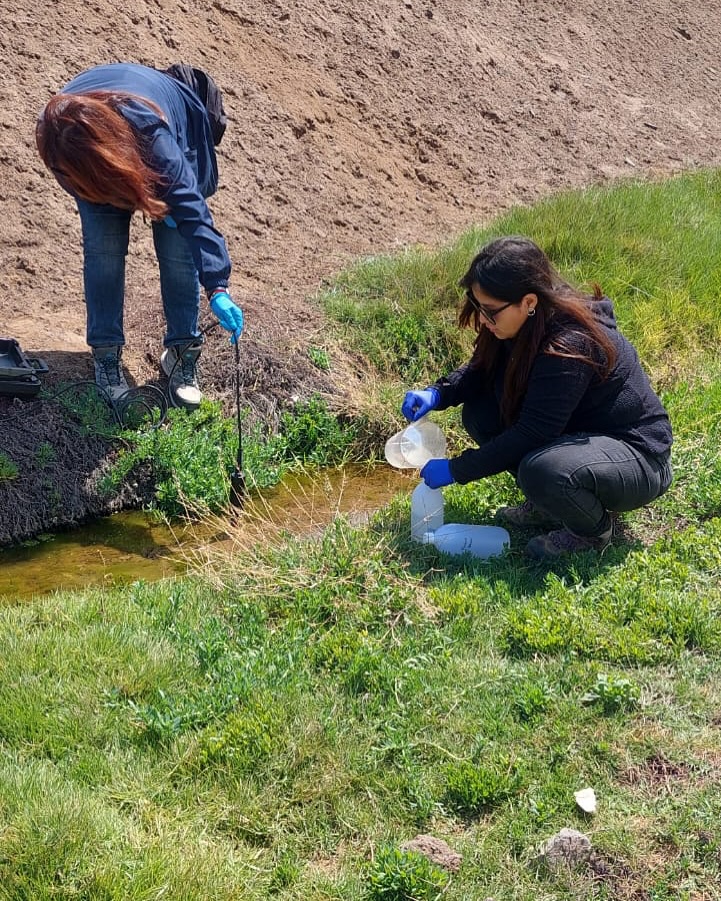
Field water monitoring at Vertientes de La Chimba Norte. Photo: Raíces Endémicas
Limits of our approach
We want to be clear about what this is and what it is not.
GoSphereX does not replace global biodiversity databases. We do not produce systematic ecological assessments. We do not claim that our pilot project’s data is representative of anything beyond its specific location and time period.
What we do is ensure that the data produced by our local partners is traceable, honest, and publicly available. If someone asks how we know something is true, we can point to evidence, not stories.
This is a modest contribution. But in a sector where overclaiming is the norm, modesty might be the most radical position.
Reference
Goldstein, J.E. et al. (2026). “Environmental data justice is key for developing more effective area-based conservation approaches.” Nature Reviews Biodiversity. DOI: 10.1038/s44358-025-00126-w
Follow GoSphereX on LinkedIn or Instagram for updates on environmental accountability and data transparency.
Note
This article summarises published research for a general audience. Findings and figures belong to the cited authors. The sections on GoSphereX describe our own approach and are not part of the cited study.
Cover image at the top of this page: Vertientes de La Chimba Norte, Antofagasta, Chile. Photo: Raíces Endémicas.