What we talked about after El Lamento del Mar, a documentary on salmon farming in Chile and Norway.
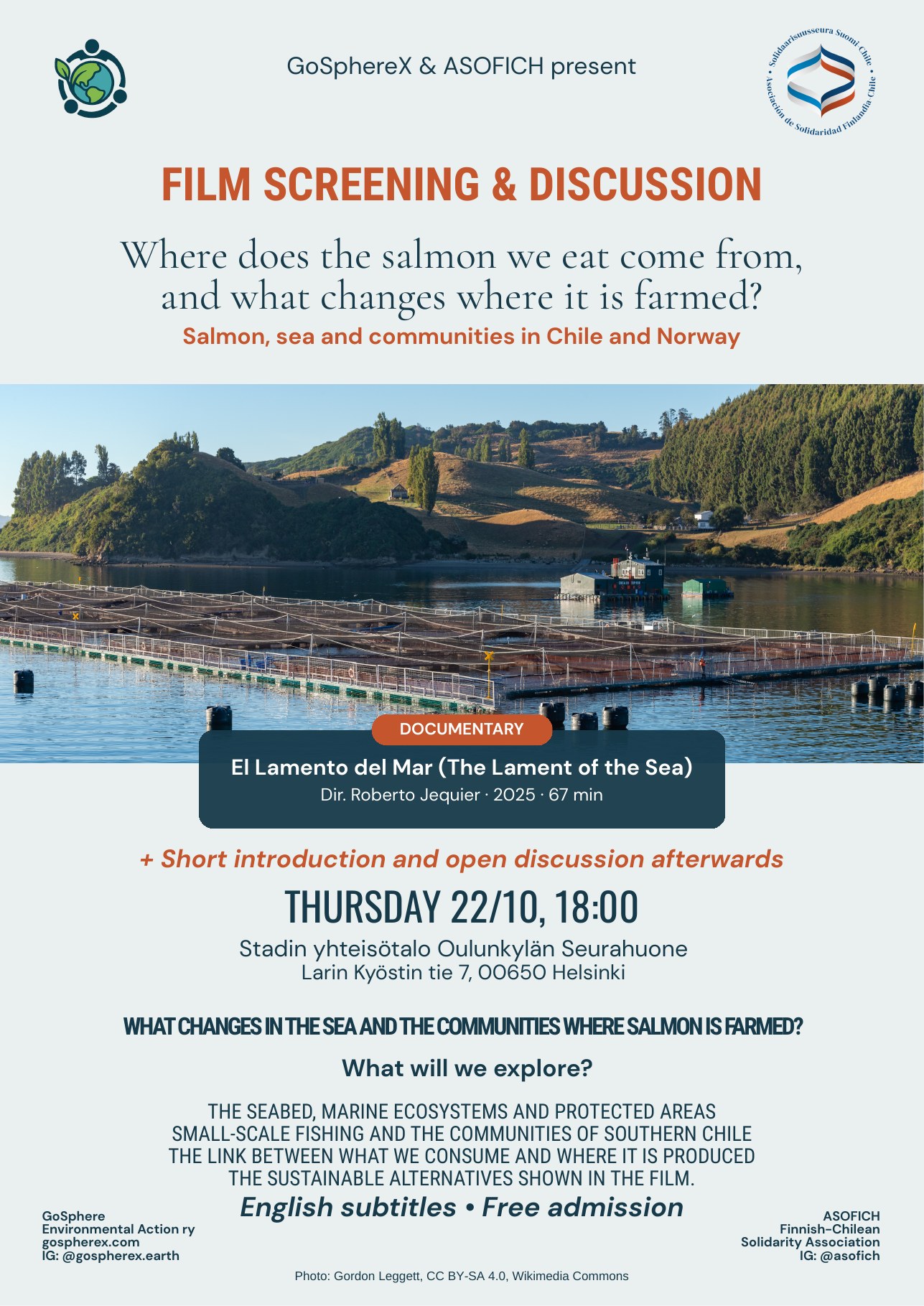
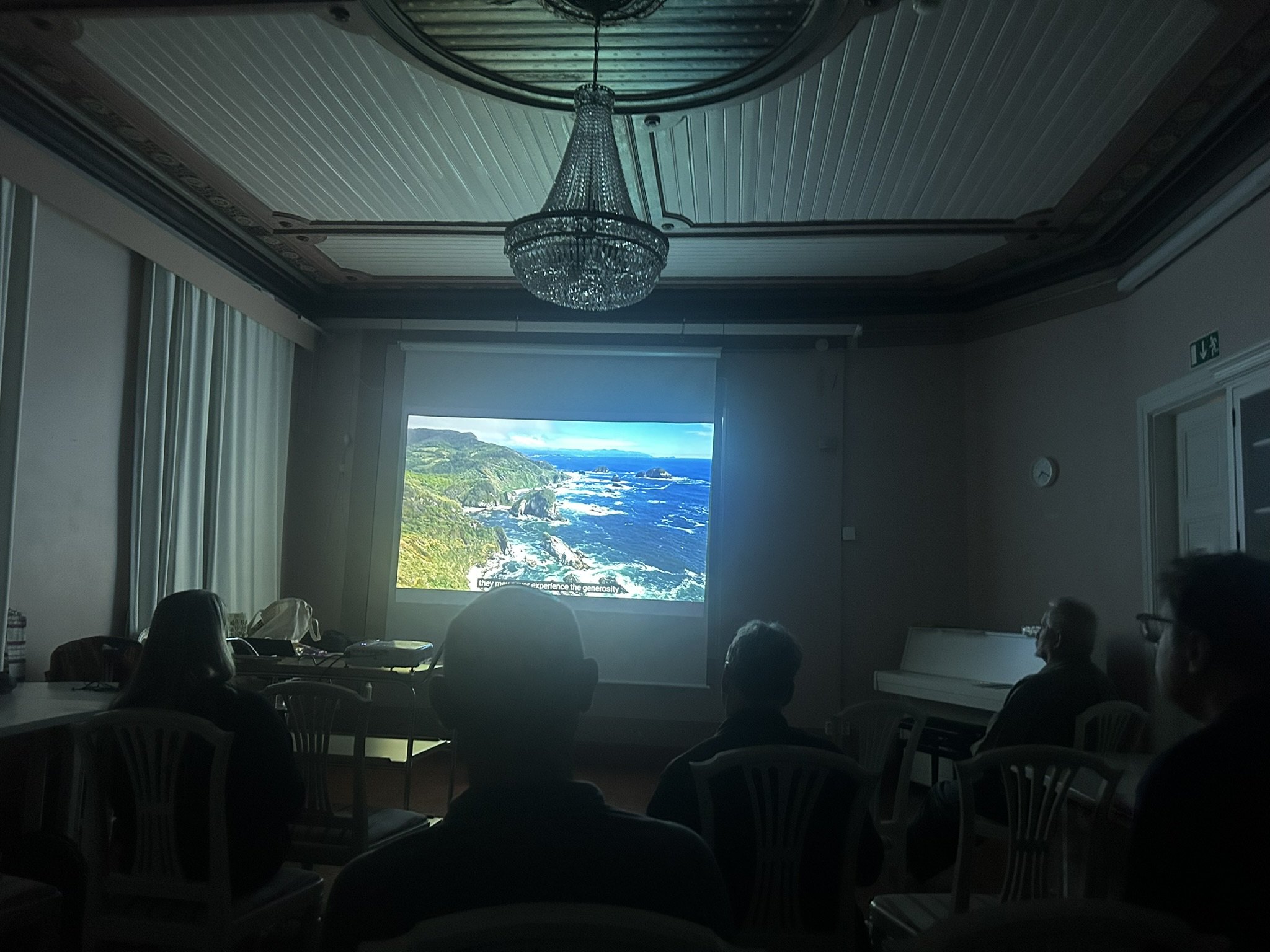
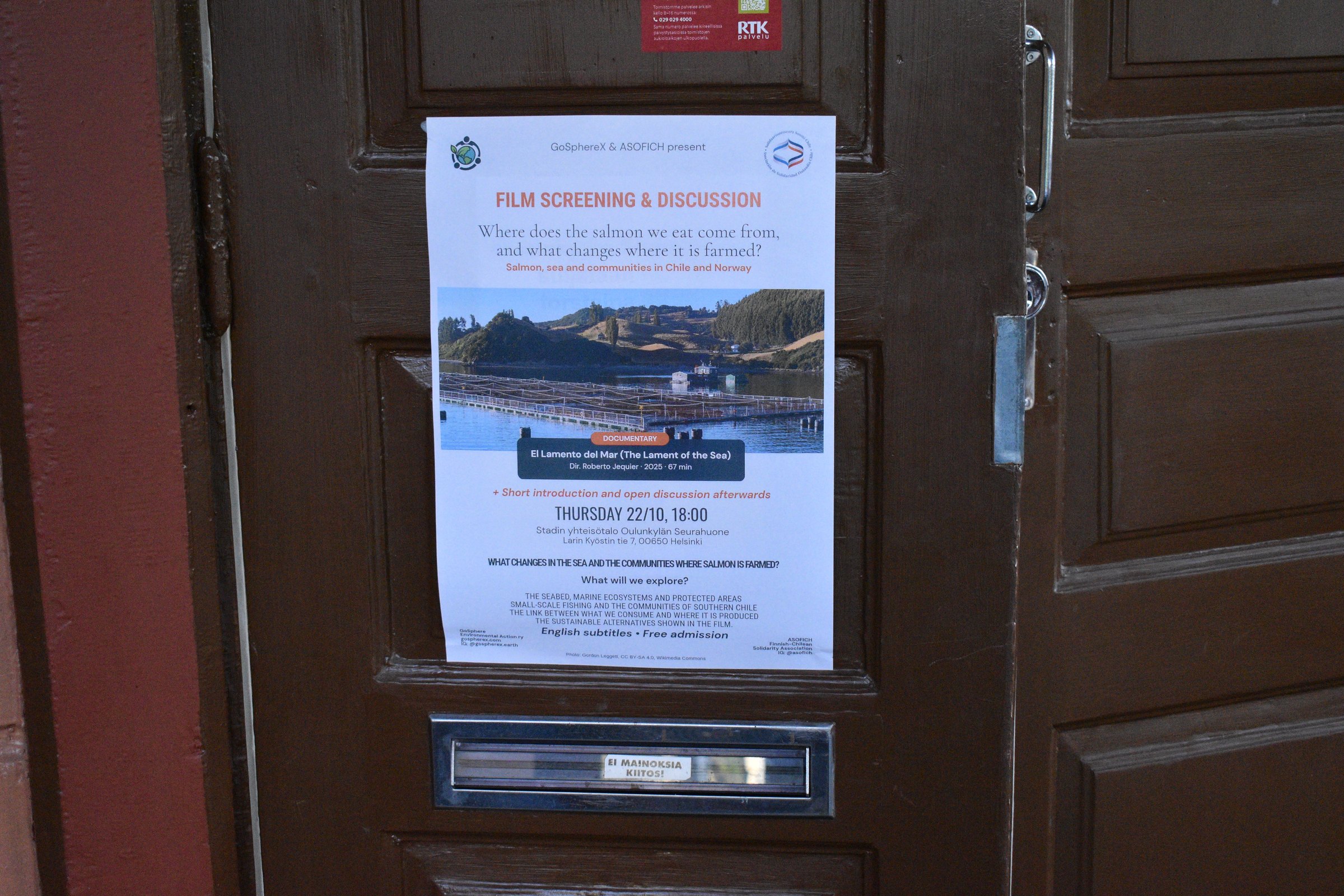
On Thursday 22 October, about seven people came to Stadin yhteisötalo Oulunkylän Seurahuone in Helsinki to watch El Lamento del Mar (The Lament of the Sea), a 2025 independent documentary by Roberto Jequier. It was the fourth session of the documentary series we run with ASOFICH, the Finnish-Chilean Solidarity Association. The conversation afterwards ran longer than we had planned.
The evening
Each film in the series follows one link between the Global South and the Global North. In February we looked at lithium and water. In March, at Mapuche and Sámi voices on their land. This time, at the sea behind the salmon on our plates.
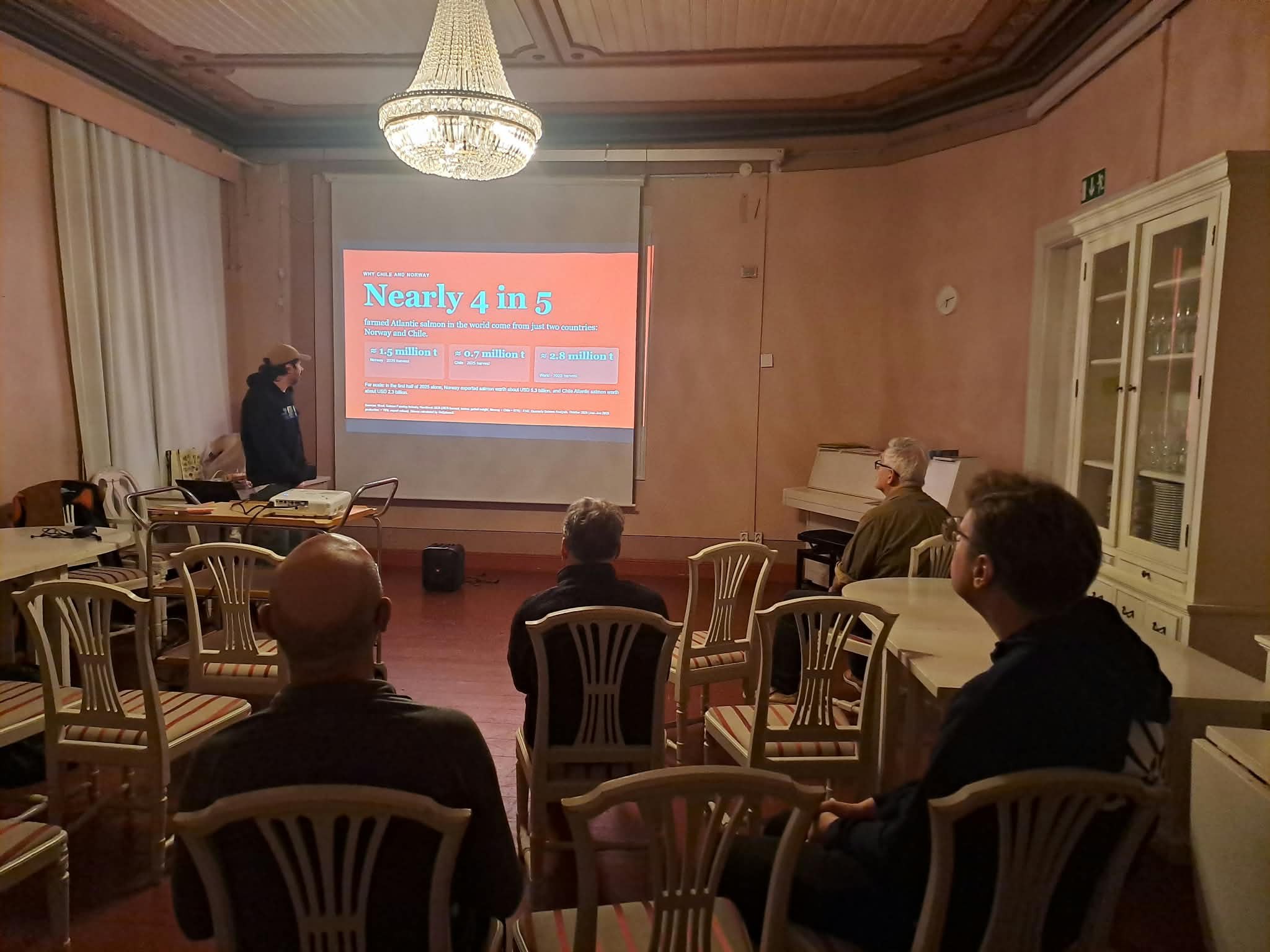
Before the film we shared one figure: nearly 4 in 5 farmed Atlantic salmon in the world come from two countries. In 2025 Norway harvested about 1.5 million tonnes and Chile about 0.7 million, out of about 2.8 million worldwide (Mowi, Salmon Farming Industry Handbook 2026; shares calculated by GoSphereX).
What the film shows
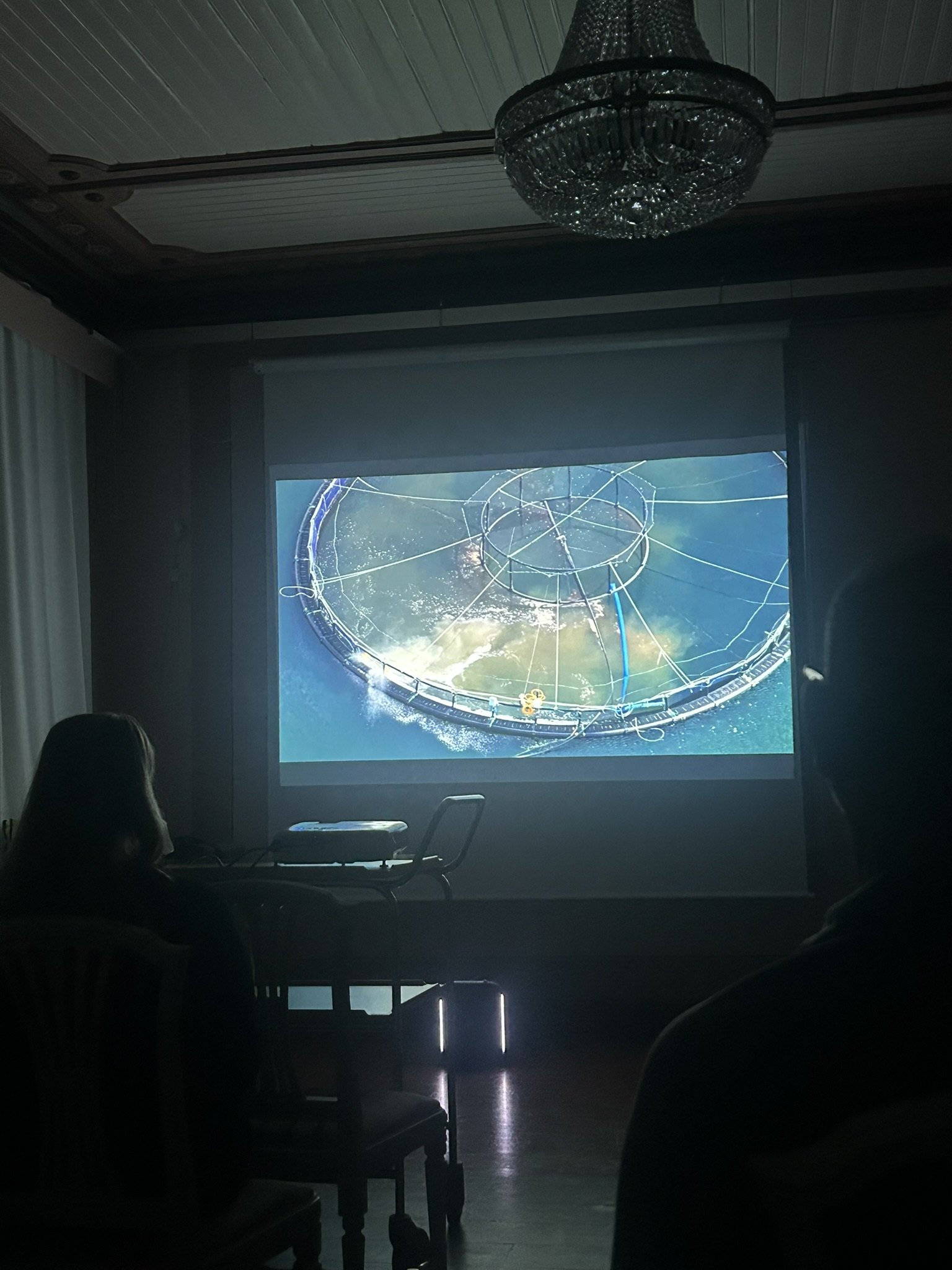
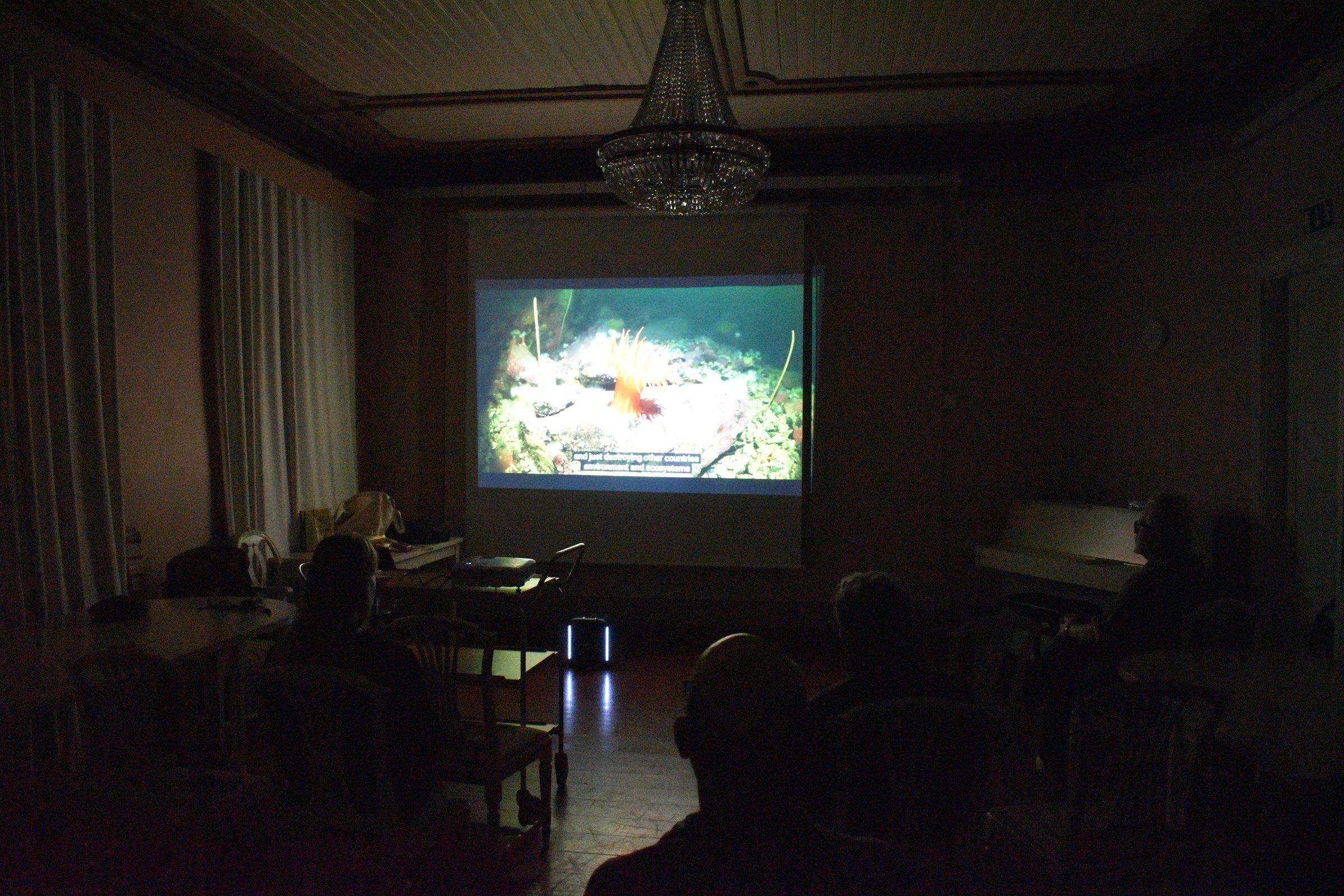
The film travels from Mowi’s headquarters in Bergen to southern Chile. It argues that open-net farms release organic waste, chemicals and copper into the sea. It shows the seabed of the Comau Fjord, cites a Chilean NGO investigation into overproduction inside protected areas, and visits a Norwegian company that farms salmon in semi-closed systems. Mowi’s view is also in the film: compared with other animal proteins, it says, salmon is a very efficient way to produce food.
These are the film’s claims and the voices it chose. It is one perspective, the director’s.
What we talked about
Salmon became everyday food. Several people remembered salmon as something expensive. Today it is in every lunch buffet. Baltic herring went the other way, from cheap everyday fish to something closer to a speciality. One attendee from abroad said they had never eaten so much salmon as in Finland. The numbers agree: in 2024 imported farmed salmon was the most eaten imported fish in Finland, about 2.6 kg per person. Baltic herring was 0.13 kg and vendace 0.23 kg (Luke; domestic fish is measured as fillet weight and imports mainly as product weight, so the figures are not fully comparable).
The fish that feeds the salmon. This was what struck people most. The film says more than a kilo of wild fish is needed to produce one kilo of salmon. One of its interviewees says about a fifth of the global marine catch goes to fishmeal and fish oil, and roughly 70% of that to aquaculture. For context, the share of marine ingredients in Norwegian salmon feed fell from about 90% in 1990 to 22.4% in 2020, with most of the rest plant-based (Nofima). These figures measure different things. We note both and do not settle the debate here.
Why better systems are not used more. The film ends with a semi-closed farm, and the room asked the obvious question: if it works, why is it not everywhere? Attendees pointed to cost, to a model that is already profitable, and to how much influence large companies have over regulation. Those are their views. The film adds a nuance: the company’s CEO says the farms cost more to build, but with lower mortality and faster growth the overall production cost is no higher than the open-net average. He also says they are too small to sell their salmon at a premium. People also talked about who can choose: someone on a tight budget has to count every euro, but many who could pay more for better production do not.
Aquaculture is not the problem in itself. One attendee brought an example from Bangladesh, where floating cages in ponds are a key source of protein and income for many families. What worried this attendee about salmon was something narrower: chemicals, antibiotics and the wild fish used as feed. The film makes the same point near the end, through a scientist: we should not equate aquaculture with salmon farming. Globally, aquaculture overtook capture fisheries for the first time in 2022, with 51% of aquatic animal production (FAO). Ideas from the room included small fish from Finnish lakes, Baltic herring and vegetarian days in schools.
One thing worth getting right
Near the end, the film says that eating Baltic fish more than twice a year is not recommended. The real advice depends on the country and on who is eating:
- Sweden (Livsmedelsverket): children, young people and women who are or may become pregnant should eat fatty fish from the Baltic, such as herring and salmon, no more than 2 to 3 times a year. Others, up to once a week.
- Finland (Ruokavirasto, 17 September 2024): children under school age and women of childbearing age, pregnant or breastfeeding can eat wild salmon and large Baltic herring (over 19 cm) once every two months. No exception applies to others.
Both refer to wild fish from the Baltic Sea, not to farmed salmon.
The question we took home
Someone asked whether fish farming in Finland is any different from Norway and Chile. Nobody in the room knew, so we promised to find out. The short answer: Finland farms very little salmon for food. In 2025, about 95% of its farmed food fish was rainbow trout (Luke). The full answer comes in our next piece.
Thank you
To Roberto Jequier and Ozono3 for authorising the screening, to ASOFICH, to Stadin yhteisötalo Oulunkylän Seurahuone for the space, and to everyone who came and stayed to talk.
What it cost
Roberto Jequier and Ozono3 authorised the screening free of charge. The only expense of the evening was a few euros for refreshments, paid from the surplus of our first small fundraising campaign, which we will report to the Helsinki Police Department at the end of November. That campaign was set up with an 83/17 split: 83% (€2,000) for Raíces Endémicas’ work at La Chimba, and 17% (€400) for documented campaign costs.
GoSphereX takes no position for or against the salmon industry. The film’s claims are the film’s, and the views shared in the room belong to the people who shared them.
Read the follow-up: Is fish farming in Finland different? What we found
Follow GoSphereX on LinkedIn or Instagram for updates on environmental accountability and community-led action.
Sources: Mowi, Salmon Farming Industry Handbook 2026; Luke, Fish consumption 2024 and Aquaculture 2025; Nofima, Utilization of feed resources in Norwegian salmon production (updates for 2013 and 2020); FAO, The State of World Fisheries and Aquaculture 2024; Ruokavirasto (17.9.2024); Livsmedelsverket. Film: El Lamento del Mar, Ozono3, 2025.
Pienkeräysnumero RA/2026/413 (Helsinki Police Department, valid 31.03.2026–29.06.2026). Organizers: Alejandro Araya (Chairperson), Soile Araya (Vice-Chairperson), Jenni Keväänvirta (Secretary), board members of GoSphere Environmental Action ry (Y-tunnus: 3583160-5). Funds support community-led wetland restoration at Vertiente de La Chimba Norte (Antofagasta, Chile) implemented by Raíces Endémicas, and environmental education activities of GoSphere Environmental Action ry in Finland. Contact: contact@gospherex.com
Cover image at the top of this page: Salmon farms in southern Chile. Photo: Sam Beebe / Ecotrust, CC BY-SA 3.0, via Wikimedia Commons.